
Voice cloning consent: whose voice you can copy, and how to ask
Voice cloning consent in plain words for Indian creators, teachers and small businesses: whose voice you may clone, how to ask in writing, what to tell viewers and what never to do. General information, not legal advice.
· 5 min read · 1.2K views · by the Cortex Digital Hub team
Record 10 to 20 seconds of your own voice, tick the consent box, and the clone stays only in your browser. Free · no sign-up · nothing uploaded
Clone your own voice → → Opens AI Voice Over & Clone · runs in your browser
Voice cloning consent comes down to one question: did the person whose voice this is clearly say yes? If it is your own voice, you already have the answer. If it is anyone else's, you need their permission, ideally in writing, before you record a single second. This post walks through whose voice you can clone, how to ask, what to tell your viewers, and the uses that are never fine. It is general information for creators, teachers and small businesses in India, not legal advice.
Here is a common situation. Your sales head has a lovely, calm voice and you want it on every project video. Or your father used to read stories to your children and you wonder if a clone could keep reading them. Both start from a good place. Both still need a clear yes.
What voice cloning consent means
A voice is personal. People recognise each other by it, trust it on the phone and act on what it says. A clone copies that, which is why the person it belongs to should decide how it is used.
Good consent has four parts:
- It is clear. The person says yes to cloning, not just to being recorded.
- It is specific. They know what you will make and where it will be shown.
- It is recorded. A WhatsApp message or an email you can find later.
- It can be withdrawn. If they change their mind, you stop and delete the voice.
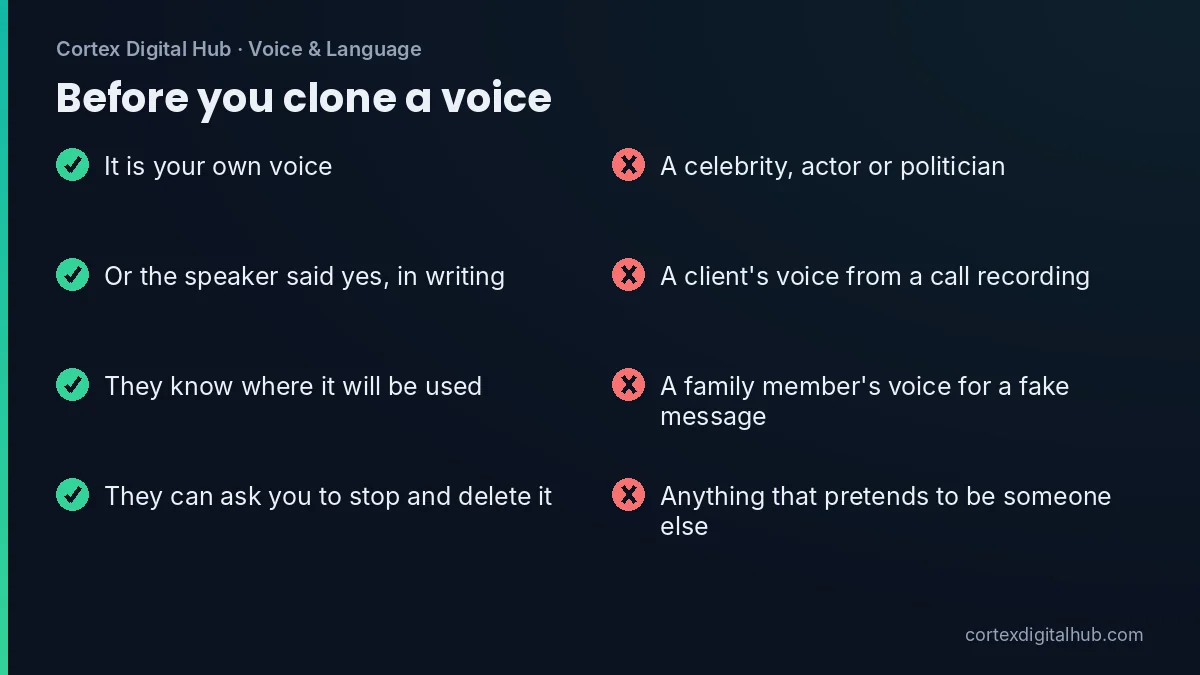 Your own voice, or a clear yes in writing. Never a voice that pretends to be someone.
Whose voice can you clone?
Your own. This is the simplest and most useful case: a voice over for your Reels, a course, a product demo or a status video, in your own sound without recording every line. Our guide to cloning your own voice for free covers the steps, and how to record a voice sample for cloning helps you get a clean 10 to 20 seconds.
A colleague, presenter or family member who agrees. Ask first, explain where it will be used, and keep their reply. If they leave the company or change their mind, stop using the clone.
Nobody else. Not a film star, not a cricketer, not a politician, not a client whose call you recorded, not a teacher from a YouTube video. If you need a voice and do not have permission, use one of the 19 library voices in AI Voice Over & Clone, which include Indian, American and British accents.
How to ask for permission
Keep it short and plain. Something like this works on WhatsApp:
"Hi Ravi, I would like to clone your voice with an AI tool to narrate our project walkthrough videos on YouTube and Instagram for the next six months. You can hear every video before it goes out, and you can ask me to stop and delete the voice at any time. Is that okay with you?"
Wait for a clear yes. A thumbs-up emoji is weaker than "Yes, that's fine." Save the chat. If the use changes later, say from social videos to TV ads, ask again.
For paid work with a voice artist, put it in the contract: what the clone will be used for, for how long, the fee and what happens to the voice at the end.
Fine and not fine: real examples
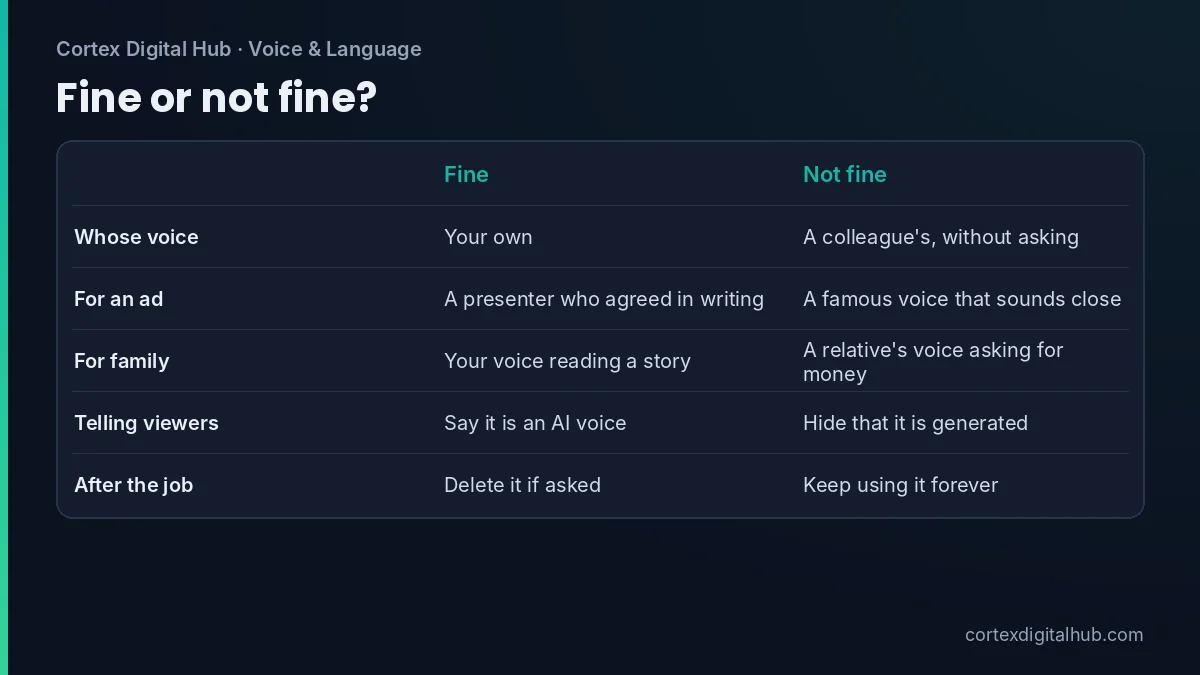 The difference is almost always permission and honesty.
Some uses are never fine, whatever the reason:
- A voice message in a relative's voice asking for money, an OTP or bank details.
- A famous person's voice endorsing your product, even "as a parody".
- A boss's or official's voice giving instructions they never gave.
- A clone of someone who has died, without the family's agreement.
- Any voice used to scare, shame or harass someone.
These are the uses that make scam calls work. Do not add to them.
Tell viewers it is an AI voice
Even with permission, be honest with your audience. A line in the caption such as "Voice over made with AI" or "AI narration, voice of our founder, used with permission" is enough. It costs nothing and protects trust.
Platforms are moving the same way. The Government of India's release on AI-generated deepfakes says the IT Rules, 2021 were amended on 10 February 2026 and that platforms must ensure clear labelling of permitted AI-generated content. Use whatever AI label your platform offers when you upload.
How the tool handles your voice
AI Voice Over & Clone is built around the safe uses:
- A consent tick is required. You cannot save a clone until you confirm it is your own voice or you have the speaker's permission.
- Nothing is uploaded. The voice engine runs in your browser, so your recording and your scripts stay on your device. Our post on why browser-based tools are safer explains the difference.
- Clones stay in one browser. A voice you clone is kept only in that browser on that device. Clear the site data and it is gone.
- Library voices are ready. If you cannot get permission, pick a library voice instead.
To clone, press Clone a voice, read the short text for 10 to 20 seconds in a quiet room, or use a clean recording of one person speaking. If your sample is inside a video, pull the audio out first with Video to MP3. The first time, the engine downloads once (about 520 MB for English, about 1.6 GB for the other languages), then works from your browser.
If someone clones your voice
Voice scams use short clips from Reels, voice notes and videos. A few habits help:
- Agree a family code word for urgent requests about money.
- Call back on a number you already have before acting on a voice message.
- If you find a fake, save the link and the date, report it to the platform, and contact the cyber crime helpline or police for anything serious.
If you have a suspicious voice note, Voice to Text gives you a written copy to share with family or the police, without uploading the recording anywhere.
Key takeaways
- Clone your own voice, or a voice whose owner clearly agreed, in writing.
- Say what you will make, where it goes, for how long, and that they can withdraw.
- Never clone a celebrity, politician, client or relative to say things they did not say.
- Label AI voices in your captions; platforms in India now have to label permitted AI content.
- In AI Voice Over & Clone, the consent tick is required and clones stay in your browser.
- For pictures and video, the same rules apply: see the AI Video Generator and only use faces of adults who agreed.
Frequently asked questions
Is it legal to clone someone's voice in India?
This post is general information, not legal advice. The safe rule is simple: clone only your own voice or a voice whose owner has clearly agreed in writing, and never use a clone to pretend to be someone. For commercial work or anything unclear, ask a lawyer.
Can I clone my own voice?
Yes. Cloning your own voice for your videos, courses or Reels is the cleanest use. In AI Voice Over & Clone you record 10 to 20 seconds, tick the box confirming it is your voice, and the clone is kept only in your browser.
How should I ask someone for permission to clone their voice?
Ask in writing, even on WhatsApp or email. Say what you will make, where it will be shown, for how long, and that they can ask you to stop and delete the voice at any time. Keep their reply.
Can I clone a celebrity or politician's voice for fun?
No. Even as a joke, a clone of a well-known voice can be passed around as real, can mislead people and can harm the person. Use a library voice instead.
Do I need to tell viewers that a voice is AI-generated?
It is good practice to say so in the caption or description. India amended its IT Rules in February 2026 so that platforms must ensure clear labelling of permitted AI-generated content, and many platforms ask creators to disclose it.
Where is my cloned voice stored?
In AI Voice Over & Clone, a cloned voice is kept only in the browser on the device where you made it. It is not sent to Cortex Digital Hub or anyone else. Clearing the browser's site data removes it.
What if someone clones my voice without asking?
Keep the link, a copy and the date, report it to the platform where it appears, and warn family and colleagues not to act on voice messages asking for money. For anything serious, contact the cyber crime helpline or the police.