
Real estate email marketing in India: the complete playbook
Real estate email marketing works when every lead gets a useful welcome within a minute, a steady drip until they visit, and honest launch and price news. Here is the full system, from DNS setup to the numbers worth tracking.
· 5 min read · 1.3K views · by the Cortex Digital Hub team
Drop in your project creative, add Call and WhatsApp buttons, tag the links with UTMs and send yourself a test. Free · up to 15 test emails a day
Build your first property email → → Opens Email Composer · runs in your browser
Real estate email marketing in India means three things done well: a welcome email to every new lead within a minute of the enquiry, a calm drip of useful emails until they visit the site, and honest news when something real happens, such as a launch or price revision. Behind those, your domain must be authenticated so the emails land in the inbox. This playbook covers each piece, with the timings and numbers we would use for a mid-sized project.
What real estate email marketing does that ads cannot
Ads and portals generate enquiries. They do not stay with the buyer for the six to eighteen months a home purchase often takes. Calls and WhatsApp messages are personal but expensive in time, and buyers tire of them quickly.
Email fills that gap. It carries detail that a WhatsApp message cannot: floor plans, a construction update with photos, a payment plan table, a location guide. It costs a fraction of a rupee per message. And because the buyer reads it when they choose, it rarely feels intrusive if the content is useful.
What it will not do is close a sale on its own. Its job is to move people to the next step, usually a site visit.
The emails every project needs
| Trigger | When | Job | |
|---|---|---|---|
| Welcome | New enquiry | Within 1 minute | Confirm, share key facts, offer a call |
| Nurture drip | After welcome | Weekly, then fortnightly | Answer buyer questions one at a time |
| Site visit confirmation | Visit booked | Instantly, plus reminders | Cut no-shows |
| Launch | New tower or phase | Pre-launch, day, follow-up | Bring warm leads back |
| Price revision | Real price change | 7–14 days before | Give a fair deadline |
| Construction update | Monthly | Same day each month | Build trust with buyers |
| Partner update | Inventory or offer change | As needed, weekly at most | Keep brokers accurate |
Start with the first two. A welcome and a short drip will do more than a monthly newsletter nobody asked for.
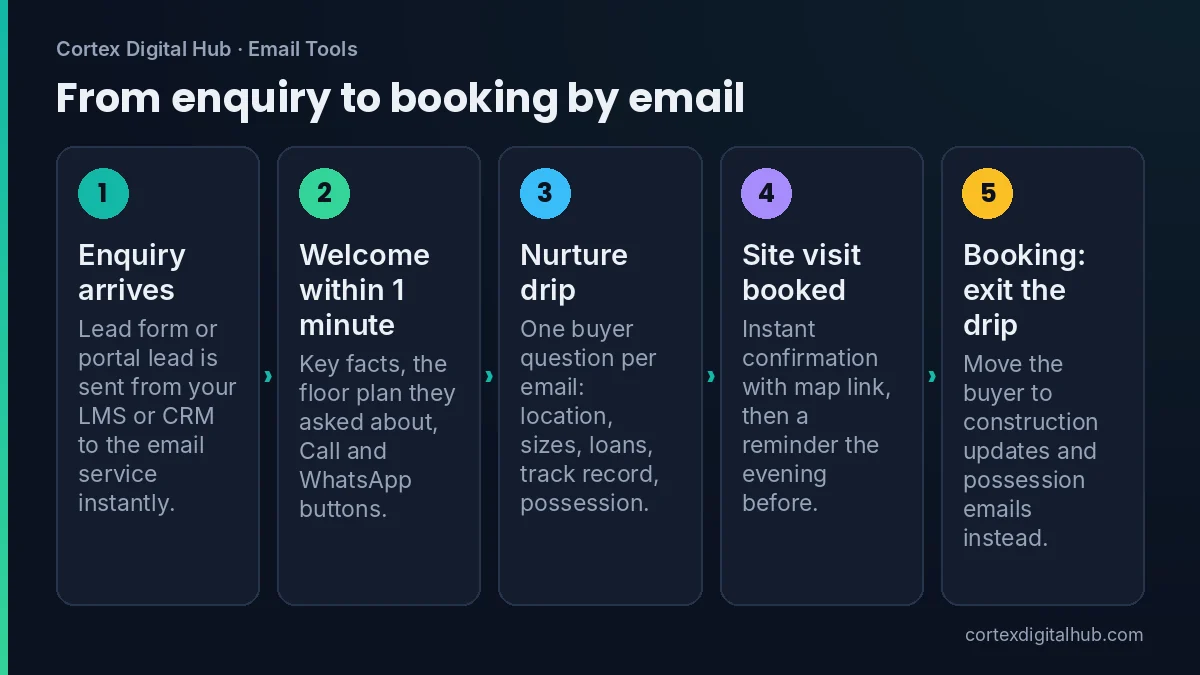 Each email has one job: move the buyer to the next step.
Welcome every lead within a minute
The first minutes after an enquiry are when the buyer is still holding the phone and still thinking about your project. A welcome that arrives then gets read. One that arrives the next morning competes with three other developers.
Automate it. Your lead management system or CRM should send the lead to your email service the moment the form is submitted; the connect your LMS guide walks through the flow. Keep the welcome short: thank them, give the project's three most useful facts, show the floor plan they asked about, and offer a Call button and a WhatsApp button.
Clean addresses before they enter the flow. Typos such as gmial.com are common on mobile forms; the free Email List Cleaner fixes them in your browser, and our guide on how to clean an email list covers what else to remove.
Drips, launches and price revisions
A nurture drip answers the questions buyers have in roughly the order they have them: location and connectivity, configurations and carpet area, amenities, payment plans and loans, builder track record, possession timeline. One topic per email. Stop the drip the day they book.
Launch and price emails carry the most risk of sounding pushy. Two rules keep them honest:
- Only state deadlines that are real, and keep them. A "last 3 days" that repeats every month teaches buyers to ignore you.
- Under the RERA Act, a project generally cannot be advertised before it is registered, and ads must show the registration number and the authority's website. Treat launch emails as ads. This is general information, not legal advice.
Site visits and channel partners
The site visit confirmation is a service email, not a marketing one. Send it instantly with the date, time, a map link, the name and number of the person meeting them, and a reschedule link. Follow it with a reminder the evening before.
Channel partners need a separate list and a separate rhythm: inventory status, price sheets, creatives and incentive news. Never mix them into your buyer list, and never send them buyer-style marketing.
Set up sending before the first campaign
Gmail and Yahoo have required authentication since February 2024, and Microsoft applied similar rules to Outlook.com from May 2025. Before you send anything in volume:
- Send from your own domain through a sending service, not a personal mailbox.
- Publish SPF and DKIM for that domain. Our explainers on SPF records and DKIM show the records.
- Add a DMARC record, starting at
p=none:
_dmarc.yourdomain.com TXT "v=DMARC1; p=none; rua=mailto:[email protected]"
- Add a one-click unsubscribe to marketing emails and keep spam complaints under 0.3%, ideally under 0.1%.
The Sending setup page gives you the exact records for your domain with live green or red checks. The full list of rules is in our guide to Gmail bulk sender requirements.
Design matters less than you think, but width does not. Keep the email around 600 px wide, as explained in email template width, so a 1080 × 1350 creative scales cleanly. The Email Composer slices your creative into image strips, adds live text and real buttons, and keeps the footer compliant.
Metrics that matter for property email
Open rates have been inflated since Apple Mail Privacy Protection began pre-loading images in 2021. Use them as a rough trend, not a score. Watch these instead:
- Click rate on floor plans, pricing and the site visit button. A range of 1–4% is common for property lists, but it varies widely with list quality.
- Site visits booked from email, tracked with UTM tags on every link.
- Spam complaint rate, kept below 0.1%.
- Bounce rate, which should stay under about 2%. Higher means your lead forms are collecting bad addresses.
- Unsubscribes after each email, which tell you when a topic or frequency is wrong.
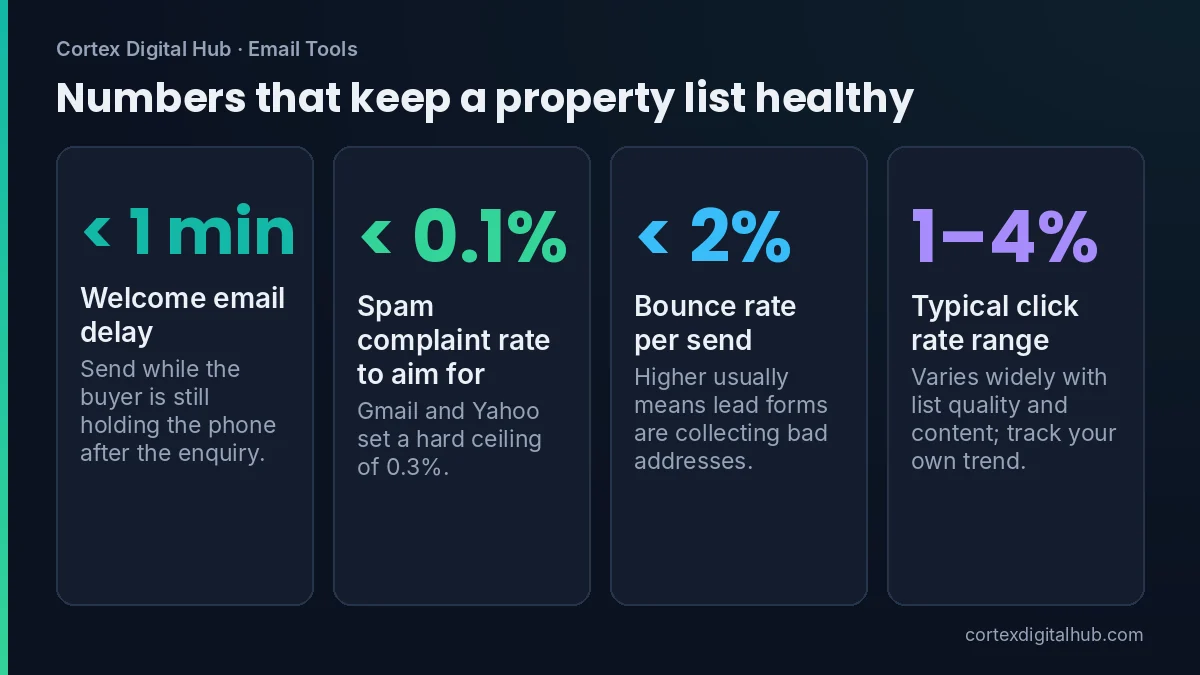 The thresholds that keep a property list healthy.
Cost is rarely the problem. A developer sending 1,60,000 emails a month through its own Amazon SES account pays SES about $16 (≈ ₹1,520) plus ₹240 in Cortex fees at ₹1.50 per 1,000; see pricing. If emails are landing in spam, start with why emails go to spam.
What to do this week
- Authenticate your sending domain with SPF, DKIM and DMARC.
- Connect your lead form or LMS so every lead gets a welcome within a minute.
- Write five drip emails, one buyer question each.
- Build a site visit confirmation with a map link and a reschedule link.
- Tag every link with UTMs and review clicks and site visits monthly.
Frequently asked questions
Does email marketing still work for real estate in India?
Yes, for the long middle of the buying journey. Property decisions take months, and email is the cheapest way to stay useful between the first enquiry and the site visit. It works best alongside calls and WhatsApp, not instead of them.
How often should a developer email leads?
Weekly for the first month after an enquiry, then every one to two weeks, then monthly. Send extra only when there is real news: a launch, a price revision or a construction milestone.
What is a good open rate for property emails?
Open rates are unreliable since Apple Mail Privacy Protection loads images automatically, so treat them as a rough signal. Clicks to floor plans or pricing, and site visits booked from email, tell you far more.
Can I email leads from property portals?
Only for the purpose they enquired about, and with a clear way to opt out. Portal leads did not sign up for your newsletter, so start with a welcome that asks whether they want project updates.
Should the sales team send emails from Gmail?
Not in bulk. Personal Gmail and Workspace accounts have daily sending caps and are not built for campaigns. Use a sending service such as Amazon SES with your own domain authenticated.
What should every property email include?
The project name, RERA registration number where it is an advertisement, a clear next step such as booking a site visit, a phone and WhatsApp button, your office address and an unsubscribe link.
How much does real estate email marketing cost?
Sending is cheap. A developer sending 1,60,000 emails a month through its own Amazon SES account pays roughly ₹1,500 to SES plus ₹240 in Cortex fees. The real cost is the time to write good emails.
Build your first property email → →